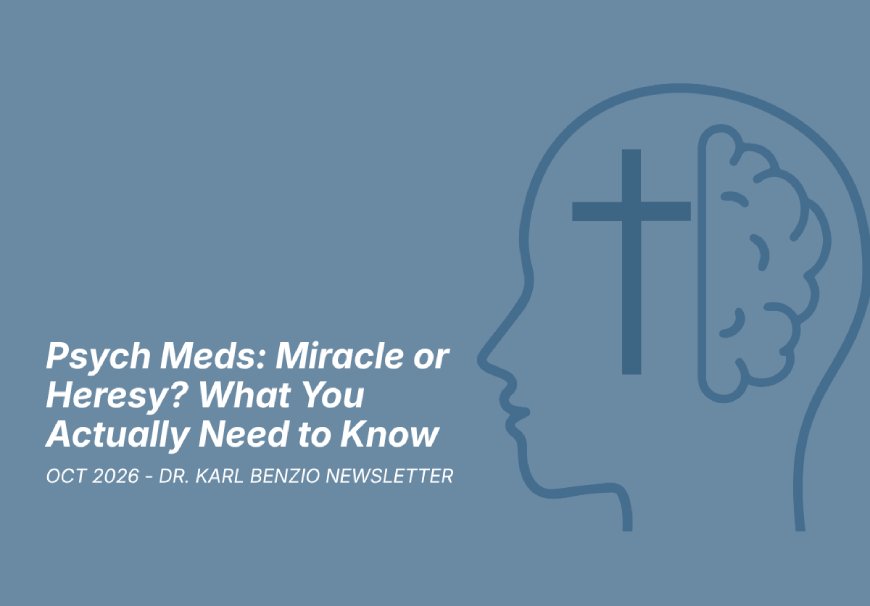
Psych Meds: Miracle or Heresy? What You Actually Need to Know
September 16, 2026 |
This month I’m getting ready to teach at the online Church Mental Health Summit (see more details below) and I’m blessed and excited to teach about a very important, but usually so-misunderstood topic – psychiatric medication. In almost every conversation I have about mental health with pastors or a church group, the stigma and theological controversy around psychiatric medications raises blood pressure and heart rates. But I’ve also found this is one where accurate information has been a game changer and life saver for so many of my patients! In fact, every couple weeks I receive an email, text, or in person thank you from a former patient – or one of their family members – thanking me for saving their, or their family members life. And it all pivoted on my explanation of the role of psychiatric medications.
What follows is a bird’s-eye view of that teaching. The full session goes deeper into brain science, clinical guidance, and case discussion, but I wanted to give you the key takeaways here. That way, whether you’re a counselor, a pastor, a parent, or someone quietly wondering if medication might help you, I always want my listeners to leave with practical tips they can immediately apply.
In my experience, few topics stir up more confusion in Christian circles than the role of psych meds – whether they’re evil and heresy, or a miracle and cure. Some people see psych meds as a lack of faith, others like the whole answer. Both miss the mark.
After 37+ years of practicing psychiatry, here’s where I land: psychiatric medications, used correctly, are a God-given miracle of the natural world to patch the broken circuits of our natural physical design. They are never a cure, nor are they ever a substitute for Him.
Two Quick Stories to Consider
Katrina (disguised name) was a people-pleaser with a poor sense of worth, and she tried to feel in control by controlling everything outside herself. She was battling an eating disorder, anxiety, depression, and compulsive exercise. For years, people anointed her with oil and prayed over her many times. Adding the right medication quieted the obsessing and the anxiety enough for her to work with her treatment team and start eating again. Over the next 18 months, she now had a brain circuit patch and better nutrition for her brain/mind to work, so she was able to learn and implement the psychospiritual coaching of her treatment team thus overcoming her eating disorder while no unashamedly re-engaging with God applying the Bible more easily to her life.
Sarah (disguised name) was a 17-year-old pastor’s kid who grew up feeling like she lived in a fishbowl, where appearances were everything, people were judging, and she needed to be the perfect girl to show her dad was a good pastor. Her constant fear of others judging her evolved into panic attacks and then a deep depression. Being overwhelmed, she wanted the pain to end, so started contemplating thoughts of ending her life. Her pastor father believed psychology, psychiatry, and especially psychiatric medications were evil and heresy. “The Bible + anything is heresy!” So he didn’t want her in treatment. Sarah’s mother, fearing losing her daughter, threatened divorce if husband didnt agree to a psychiatric evaluation for Sarah. He relented, and after the evaluation, I shared my theological views and psychiatric expertise about how God designed our mind and brain to work – spirit, mind, body integration. He was thankful for my honesty and clarity, and agreed to my proposed treatment plan for Sarah. Within two weeks on medication, Sarah felt her emotions calming, no suicidal thoughts, and real hope for the first time since before puberty. By 10 weeks she was anxiety and panic free again. We continued to work on psychospiritual issues like identity, value, purpose, worldly opinions vs God’s, tuning to station WORD and not WORLD, emotional regulation, and taking every thought captive to purge many cognitive distortions – lies – and replace with God’s truth. She started to live from a place of trust and love and away from fear and self-centered views. A little over a year later, she was doing better than she ever had her whole life and was finally able to fulfill a dream – go on an overseas missions trip for the first time!
Where would they be without medication as part of their care? Maybe still stuck. Maybe still suffering. Maybe not here at all.
What Meds CAN’T Do
Psychiatric medications can’t cure any psychiatric disorder. Not one. Ever. Thirty-seven years of treating tens of thousands and never seen a cure happen from psychiatric medications.
What Meds CAN Do
They can provide a temporary patch or bandaid on injured brain circuits, allowing your brain to work better thus reducing various symptoms to allow time and room for healing to occur allowing your injured brain circuit to temporarily improve thus reducing various symptoms which buys time and capacity to absorb the necessary psychospiritual interventions. Healing occurs when we psychospiritually learn skills to become more consistent Godly decision-makers. Doers of the Word. Through the the God-designed miracle of neuroplasticity, Godly decisions renew the mind and REWIRE our brain.
Medication can:
Decrease symptoms, such as trouble with sleep, appetite, energy, focus, obsessing, nightmares, impulsivity, anxiety, depression, fear, agitation, motivation, etc
Improve perspective, so there’s less distorted thinking
Improve perspective, so there’s less distorted thinking
Buy us time to learn, practice, and apply the psychospiritual skills we need to bring lasting change
Think of it like blood pressure medication. When you have high blood pressure, the cure is skills. Lose weight, better nutrition, exercise, improve relationship skills (conflict resolution, relationships, confession, forgiveness, stop holding grudges, don’t take everything so personal), stop alcohol, nicotine, caffeine and other drugs, go to sleep on time, pay your bills, save money, manage stress better, you get where I’m going.
But if you do all those skills today, that doesn’t cure your high blood pressure. You need months of these skills. But since we don’t want you to blow a stroke or have a heart attack, we give you blood pressure meds. No blood pressure medication cures high blood pressure. But meds reduce the symptoms of headache, blurred vision, dizziness and decrease the chance of stroke and heart attack. It protects you and buys you time to do the harder work of changing your habits – become a more consistent Godly decision-maker.
The med is a patch on an injured circuit, not a new circuit or cure. Psychiatric meds serve the same role.
Psych Meds Downside
Side effects are real, and every patient should get a list of them. Most are nuisance side effects, but some can be significant. Each person has to weigh the side effect against the benefits they get. For most psychiatric symptoms God’s given us a number of medications to find one that has the best benefit:risk ratio for you.
Since our newer meds help so much and reduce symptoms so quickly and sometimes fully, the biggest danger is being tricked into thinking the medication cured you. When we feel significant relief, it’s easy to leave God out of the healing recipe. We lose the urgency and motivation to do the underlying and necessary psychospirutual work needed to address the actual cause of our struggle. By leaving God and this core step out, we miss out on God’s natural healing principle of neuroplasticity which renews our mind and rewires our own brain. Our initial symptom discomfort is often an important warning system or wake-up call, alerting us that we need to work on something deeper in us that needs healing or correction. Don’t miss the alerting message God is using to alert us to an area we need refining in.
WHEN IS IT TIME FOR A PSYCHIATRIC EVALUATION?
- Safety is at risk, including suicidal thoughts, self-harm, psychosis, or addiction
- Your view of yourself, others, or the future is significantly distorted
- Emotions like anxiety, depression, anger, loneliness, or fear feel hard to tolerate or control
- Stress or suffering is leading to impulsive decisions
- Sleep, appetite, energy, focus, motivation, or joy are breaking down
- Counseling has stalled, or struggles keep coming back and doing damage
- Decision-making leads to unhealthy responses
- Distress or Dysfunction regularly show up in your week
- Managing regular daily responsibilities is a struggle or you often sabotage yourself
One myth I hear often is that refusing medication when you’re struggling “protects” your brain. It doesn’t. Continued unhealthy decisions actually push neuroplasticity the wrong direction and unhealthy habits get wired in our brain or circuits become injured.
10 Questions to Ask Your Prescriber
- Do you know my full medical history?
- Do you know my full drug and alcohol history?
- What’s my diagnosis, and what symptoms/criteria did you use to arrive at that?
- Which symptoms are we targeting for the medications to help ?
- What’s the goal of this medication?
- What treatment options are best suited for me?
- What are the common side effects? Are any dangerous or long-term?
- What’s the dose range?
- How long do you expect me to be on it?
- How often will you see me?
Bonus question: What other interventions, including psychospiritual aspects, go alongside taking my meds?
Practical Tips
Never stop a medication on your own. And if you’re a counselor, pastor, or friend who doesn’t prescribe, don’t advise anyone to go off their meds.
Give it time. Changes in dose – up or down – are best judged over about 12 weeks. Both the benefits and side effects (if you get side effects, they usually happen early then fade after your body gets acclimated to the dose). Changes in either direction are best judged over about 12 weeks.
Starting speed is a trade-off. A slower increase means fewer side effects but slower relief. A faster increase brings quicker relief but potentially more intensity of side effects.
Taper slowly. Coming off a medication works best in small steps, reassessing every 12 weeks along the way.
Addictive medications need extra caution and oversight. Accountability from a third-party matters – like a spouse, parent, roommate, therapist, etc
Strongly consider a specialist. A family doctor is easy, quicker, and cheaper, but this vital quality of life matter both deserves and requires a specialist – a psychiatrist for the psych meds piece. Remember, how you manage your mind/brain significantly impacts all areas of your life, so a specialist – psychiatrist – is the best option. Just like if you had significant heart issues, you would want to see a cardiologist.
Ask about genetic testing. Pharmacogenomic (PGx) testing can show which medications your body is likely to handle well or poorly.
Remember the formula: Skills + Treatment − Stressors = Functioning. Obviously Skills increases functioning. But Treatment consists of talk therapy by addressing the PsychoSpiritual (so important for the Biblical spiritual) to learn and apply skills. But for some, when the situations i listed above are at play, medications – the right ones, for the get reasons, at the right doses, at the right times – increase functioning also.
The Real Goal
God designed our brains to change based on the decisions we make. This is called neuroplasticity, so decision-making is the exercise for the brain. Medication can temporarily stabilize the disruptions, but applying Biblical truth to how we think and choose is what renews our mind and rewires our brain over time. This vital life-saving pursuit is why i call this newsletter: Renew & Rewire.
That’s why talk therapy is more than just talk. It’s therapy – an actual neurobiological intervention. Meaning it actually helps the listener Rewire their actual brain. Whether you’re a therapist, counselor, pastor, parent, or friend, you can help reduce stigma, encourage wise referrals, and integrate an understanding of the biological, psychological, and spiritual together for the struggling loved ones in your life. You are special forces on the front line of this spiritual war, where God and Satan are battling for the influence of each person’s mind.
So each person’s real goal isn’t “I want to be med-free.” Or “I don’t want to be in therapy anymore.” Or “I’ll just stay where I’m at.”
No, the real goals the Bible teaches is to pursue daily are:
- Glorify God as much as possible – Be a doer, not just a hearer of the Word, A consistent Godly decision-maker
- Love God with all our heart, soul, mind, and strength – Great Commandment
- Become more like JESUS on a daily basis – called to holiness.
- Go make disciples of JESUS – Great Commission
Nowhere in the Bible does it say I should do those 4 on my own without any help from a pillow, car, wife, money, food. Each of these can become idols and interfere with those 4 Goals. But I don’t think of giving those up. So why should we be so uniquely afraid of psychiatric meds.
“Guard your heart above all else, for it determines the course of your life.” (Proverbs 4:23, NLT)
Your decisions determine your life, so choose well – and help those you influence choose well too.
If you are in a season where you feel like you or a loved one needs to find a resource to help, see the list below for some resources/steps I recommend.
Here are some online resources to go through to get access to help:
When calling these places, make sure you ask if the provider is Christian & incorporates faith into their treatment.
- Call Honey Lake Clinic (888.428.0562) – ask for outpatient provider network options
- Go to Christian Medical & Dental Association- search for providers/treatment centers
- Call Focus on the Family – 1 hour of counseling free & will give therapists for next steps
- Go to Psychology Today – filter for Christian options for therapists
- Christian Care Connect from the AACC – take the assessments & search for providers
- Go to Light Counseling – opening availability in a lot of states.
- Mashah Prayer is a healing prayer ministry run by Ruth Hendrickson
Here are some more local avenues to call & ask who they refer to for therapy or prescribing medication:
- Call several local churches who seem prioritize mental health
- Ask Christian friends
- Call local Christian schools and ask who they refer mental health or addiction issues to
- Primary Care Doc for Christian referrals
- Call local counseling practices and ask if they have a Christian therapist who integrates their faith when helping someone renew their mind
Related Post